Camille
Chapter 5: The Riddle of the Lost Painting
At the library, Camille discovers a mysterious painting with magical colors. Who is the artist who created it? And why do his paintings seem so familiar to her?
Reading difficulty
A week after restoring the park, Camille goes to the library. She loves this quiet place filled with old books.

That day, something unusual caught his attention: in an exhibition hall, a large painting shone with a soft, familiar light.
Camille approaches. The painting depicts a magical landscape: a field of multicolored flowers, a pink and purple sky, and a stream with golden reflections. The colors seem alive, like those in her paintings! She reads the plaque:
"The Work of Lost Colors, by Augustin Lemerle."
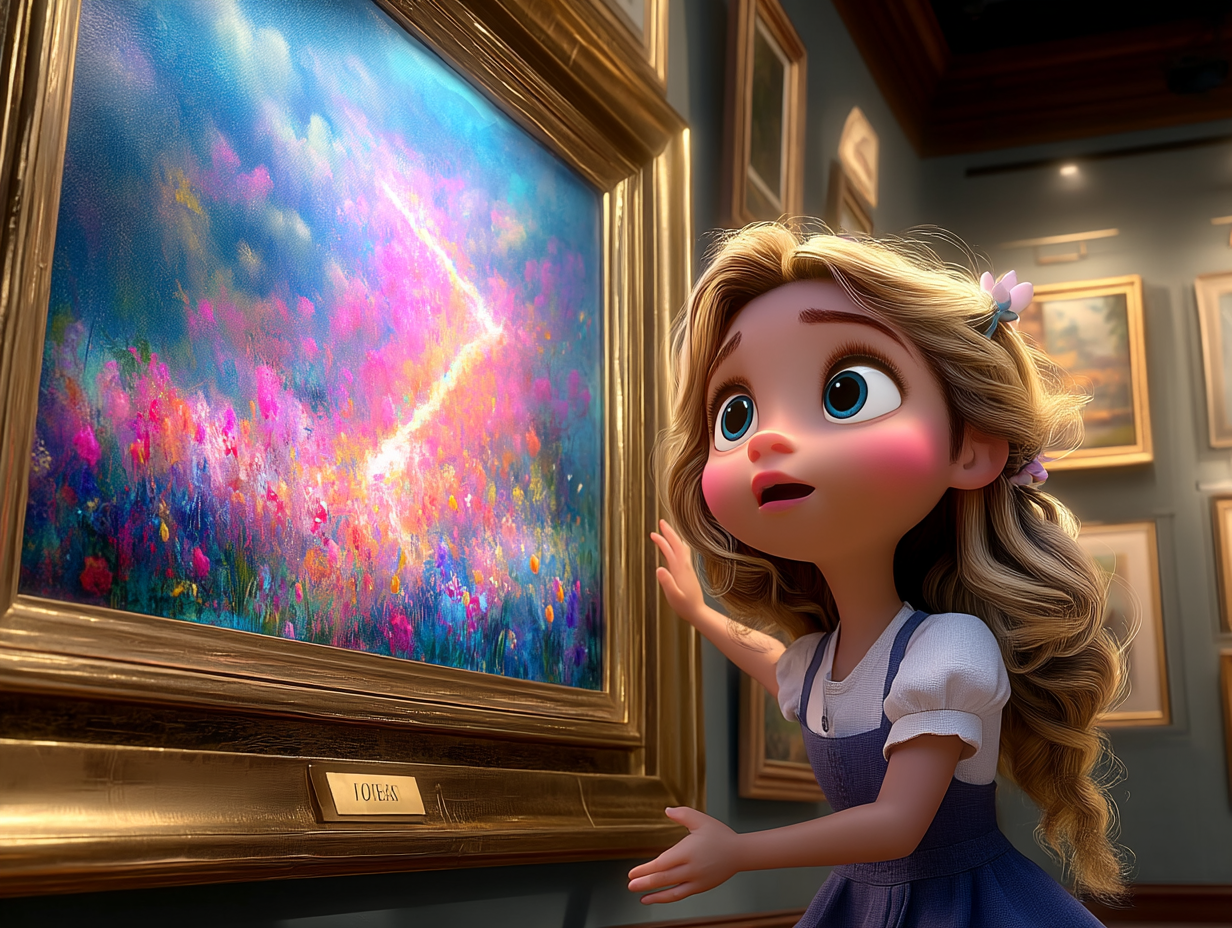
Camille notices hidden details: small flowers identical to those in her notebook, and butterflies like those in her garden.
The librarian approaches. "This painting is special, isn't it?" Camille nods. "Yes, it looks like it's... alive."

"There's a legend. Augustin Lemerle used magical paints. But one day, he disappeared, leaving behind a few paintings like this one."
Camille felt her heart race. "And these paintings... where did they come from?"
"We don't know, but he left clues in his works."
Camille notices a hidden inscription: "Knowledge is found where light meets shadows."
That evening, she examined her box. On the lid, an engraved motif resembled a detail from the painting. What if this box had a connection to this artist?

Camille senses that she is on the verge of a great mystery.
That day, something unusual caught his attention: in an exhibition hall, a large painting shone with a soft, familiar light.
Camille approaches. The painting depicts a magical landscape: a field of multicolored flowers, a pink and purple sky, and a stream with golden reflections. The colors seem alive, like those in her paintings! She reads the plaque:
"The Work of Lost Colors, by Augustin Lemerle."
Camille notices hidden details: small flowers identical to those in her notebook, and butterflies like those in her garden.
The librarian approaches. "This painting is special, isn't it?" Camille nods. "Yes, it looks like it's... alive."
"There's a legend. Augustin Lemerle used magical paints. But one day, he disappeared, leaving behind a few paintings like this one."
Camille felt her heart race. "And these paintings... where did they come from?"
"We don't know, but he left clues in his works."
Camille notices a hidden inscription: "Knowledge is found where light meets shadows."
That evening, she examined her box. On the lid, an engraved motif resembled a detail from the painting. What if this box had a connection to this artist?
Camille senses that she is on the verge of a great mystery.
A week after restoring the park's colors with her friends, Camille goes to the municipal library. She loves this quiet place filled with old books that smell of yellowed paper and history. That day, she hopes to find new ideas for her paintings and perhaps better understand the nature of her magic box.
But as she strolled among the shelves, something unusual caught her eye. In a small temporary exhibition room she had never noticed before, a large painting hung on the wall. It seemed to glow with a soft, familiar light, almost as if it were lit from within.
Intrigued, Camille moves closer for a better look. The painting depicts an enchanting landscape: a field of multicolored flowers that seem to ripple in an invisible breeze, a sky vibrant with pink and purple hues that evoke a magical sunset, and a stream with golden reflections that appears to be truly flowing. What strikes her immediately is that the colors seem alive, almost magical, just like those in her paintings.
She reads the small plaque under the painting:
"The Work of Lost Colors, by Augustin Lemerle, 1952."
Camille had never heard of this artist, but this painting awakened something within her, a strange yet familiar feeling, as if she recognized a part of herself in those brushstrokes. She moved even closer and noticed tiny details hidden in the painting: small flowers identical to those she had painted in her sketchbook, and even butterflies similar to those she had conjured in her garden. It wasn't a coincidence.
The librarian, an elderly woman with kind eyes and glasses perched on the end of her nose, approaches silently. "This painting is special, isn't it?" she asks with a mysterious smile. Camille nods, unable to tear her eyes away from the artwork. "Yes, it looks like it's... alive."
The librarian nods. "There's a legend surrounding this painting. It's said that Augustin Lemerle used very special paints, capable of bringing his creations to life. Some even said he could transform reality with his brushes. But one day, he mysteriously disappeared, leaving behind very few traces, except for a few paintings like this one."
Camille felt her heart race. "And these paintings... do you know where they come from?"
The librarian gently shook her head. "No, nobody really knows. But it seems he left clues hidden in his works. Perhaps this painting contains answers for those who know how to look."
Camille decides to examine the painting even more closely. She scrutinizes every inch of the canvas, searching for clues. And there, in a dark corner, almost invisible unless you lean in very close, she notices a small inscription engraved in the paint itself:
"Knowledge is found where light meets shadows."
She doesn't immediately understand what it means, but she instinctively feels she must keep searching. The phrase resonates within her like a key to an important secret.
That evening, back home, Camille examined her paint box by the light of a desk lamp. She looked at it from every angle, caressed the aged wood, and observed details she hadn't really noticed before. And suddenly, she saw it: on the lid of the box, a floral motif engraved in the wood seemed to correspond exactly to a detail in the painting byLemerle. This cannot be a coincidence.
"What if this box had belonged to this artist?" she murmured to herself, her eyes shining with excitement. "What if he had deliberately left clues so that someone would find it one day?"
Camille senses she's on the cusp of a great mystery. She decides to return to the library the very next day to search for more of Lemerle's works, books about his life, or any other clue to his mysterious disappearance. What she discovers could very well change everything she thinks she knows about his magical paintings and the responsibility that comes with such power.
But as she strolled among the shelves, something unusual caught her eye. In a small temporary exhibition room she had never noticed before, a large painting hung on the wall. It seemed to glow with a soft, familiar light, almost as if it were lit from within.
Intrigued, Camille moves closer for a better look. The painting depicts an enchanting landscape: a field of multicolored flowers that seem to ripple in an invisible breeze, a sky vibrant with pink and purple hues that evoke a magical sunset, and a stream with golden reflections that appears to be truly flowing. What strikes her immediately is that the colors seem alive, almost magical, just like those in her paintings.
She reads the small plaque under the painting:
"The Work of Lost Colors, by Augustin Lemerle, 1952."
Camille had never heard of this artist, but this painting awakened something within her, a strange yet familiar feeling, as if she recognized a part of herself in those brushstrokes. She moved even closer and noticed tiny details hidden in the painting: small flowers identical to those she had painted in her sketchbook, and even butterflies similar to those she had conjured in her garden. It wasn't a coincidence.
The librarian, an elderly woman with kind eyes and glasses perched on the end of her nose, approaches silently. "This painting is special, isn't it?" she asks with a mysterious smile. Camille nods, unable to tear her eyes away from the artwork. "Yes, it looks like it's... alive."
The librarian nods. "There's a legend surrounding this painting. It's said that Augustin Lemerle used very special paints, capable of bringing his creations to life. Some even said he could transform reality with his brushes. But one day, he mysteriously disappeared, leaving behind very few traces, except for a few paintings like this one."
Camille felt her heart race. "And these paintings... do you know where they come from?"
The librarian gently shook her head. "No, nobody really knows. But it seems he left clues hidden in his works. Perhaps this painting contains answers for those who know how to look."
Camille decides to examine the painting even more closely. She scrutinizes every inch of the canvas, searching for clues. And there, in a dark corner, almost invisible unless you lean in very close, she notices a small inscription engraved in the paint itself:
"Knowledge is found where light meets shadows."
She doesn't immediately understand what it means, but she instinctively feels she must keep searching. The phrase resonates within her like a key to an important secret.
That evening, back home, Camille examined her paint box by the light of a desk lamp. She looked at it from every angle, caressed the aged wood, and observed details she hadn't really noticed before. And suddenly, she saw it: on the lid of the box, a floral motif engraved in the wood seemed to correspond exactly to a detail in the painting byLemerle. This cannot be a coincidence.
"What if this box had belonged to this artist?" she murmured to herself, her eyes shining with excitement. "What if he had deliberately left clues so that someone would find it one day?"
Camille senses she's on the cusp of a great mystery. She decides to return to the library the very next day to search for more of Lemerle's works, books about his life, or any other clue to his mysterious disappearance. What she discovers could very well change everything she thinks she knows about his magical paintings and the responsibility that comes with such power.
A week after restoring the park's colors with the enthusiastic help of her friends, Camille goes to the town library. She particularly loves this quiet and peaceful place, filled with old books that smell of yellowed paper and forgotten history. The tall, dark wood shelves, the large windows that let in soft light, and the respectful silence that reigns there always comfort her. That day, a rainy Saturday afternoon, she hopes to find new ideas for her artwork and perhaps, secretly, to understand a little better the true nature of her mysterious box of magical paints.
But as she strolled leisurely among the familiar shelves, exploring sections she knew by heart, something unusual suddenly caught her eye. In a small temporary exhibition room she'd never really noticed before, tucked away at the back of the library near the local history section, a large painting hung on the main wall. What was strange was that it seemed to glow with a soft, uncannily familiar light, almost as if illuminated from within by an invisible source, as if the colors themselves emitted their own light.
Intrigued and as if drawn by a magnetic force, Camille slowly approaches to get a closer look at this mysterious work. The painting depicts an absolutely enchanting landscape that seems almost unreal: a vast field of multicolored flowers that appear to ripple in an invisible breeze, a sky vibrant with pink, purple, and orange hues that evoke a truly magical sunset, and a meandering stream with golden and silver reflections that seems to genuinely flow through the canvas. What strikes her immediately and almost takes her breath away is that the colors seem strangely alive, almost magical, just like those in her own paintings in the box. There is that same luminous quality, that same impression that the colors breathe and vibrate with a life of their own.
Camille moves even closer to the painting and carefully reads the small copper plaque attached to the gilded frame beneath the artwork:
"The Work of Lost Colors, by Augustin Lemerle, oil on canvas, 1952."
The name meant absolutely nothing to her. Camille had never heard of this artist in her art classes at school, nor in any of the books she had consulted. Yet, this painting awakened something deep within her, a strange but powerfully familiar feeling, as if she recognized an essential part of herself in those precise and delicate brushstrokes, as if she and this unknown artist shared a common secret.
She decides to examine the work even more closely, scrutinizing every detail. And that's when she notices tiny elements hidden within the composition, details that only a truly attentive eye could perceive: small, delicate, almost microscopic flowers, absolutely identical to those she herself had painted in her magic sketchbook a few weeks earlier, and even butterflies with translucent wings that look exactly like the ones she conjured in her garden during her first experiment with the paints. The resemblance is too precise, too perfect to be a mere coincidence.
Camille's heart is now pounding in her chest. She feels that this painting contains important answers, perhaps even the key to the mystery of her magic box.
At that precise moment, the librarian, an elderly woman with a gentle and kind face and grey hairWith her hair neatly styled in a bun and round glasses perched on the end of her nose, she silently approaches from behind her. "This painting is very special, isn't it?" she asks softly with a mysterious, knowing smile. Camille jumps slightly in surprise, then nods vigorously, still unable to tear her eyes away from the captivating work. "Yes, it looks... alive, as if the colors are breathing."
The librarian nodded thoughtfully, as if she had been expecting this reaction. “There’s a fascinating legend surrounding this painting and its creator. In our region, it’s said that Augustin Lemerle, a very talented but enigmatic artist who lived right here, used absolutely extraordinary, very special paints that were capable of truly bringing his artistic creations to life. Some people in the village even say that he could literally transform reality itself with his magic brushes, that the flowers he painted actually grew, that the birds he depicted began to sing. But one mysterious day, he vanished completely without a trace, without explanation, leaving behind very little information about his life, except for a few rare and precious paintings like this one.”
Camille felt her heart race even faster. Her voice trembled slightly as she asked, "And these magic paintings... do you know exactly where they came from? How did he make them?"
The librarian gently shook her head with a look of regret. "No, unfortunately, no one really knows. It's one of the great mysteries of our local history. But according to legend, it seems that Augustin Lemerle deliberately left subtle clues hidden in his works, like coded messages for future generations. Perhaps this painting itself contains precious answers for those who truly know how to look and who have an open heart to magic."
Camille felt a wave of excitement wash over her. She decided to examine the painting even more meticulously, even more attentively. She methodically scanned every square inch of the magnificent canvas, searching for hidden clues, secret messages, revealing details. Her eyes scrutinized the flowers, the sky, the stream, the shadows and the light. And there, finally, in a particularly dark corner of the painting, in the lower right, almost completely invisible unless she leaned very close to the canvas and looked at it from a certain angle, she discovered a small, delicate inscription etched directly into the dried paint itself, as if the artist had used the slender handle of her brush to write these mysterious words:
"Knowledge is found where light meets shadows."
Camille read and reread the enigmatic sentence several times. She didn't immediately understand its exact meaning, but she felt instinctively, deeply, that she absolutely had to keep searching. The sentence resonated powerfully within her like a crucial key to an important secret, like a clue intentionally left to guide someone following in Lemerle's footsteps.
That evening, back in the comfort of her room, Camille carefully took out her precious box of magic paints and examined it meticulously in the warm light of a desk lamp. She looked at it closely from every possible angle, gently caressed the old, weathered wood, and observed with renewed attention all the little details, the engravings, the ornaments she hadn't really noticed before with such care. And suddenly, in aIn a moment of illumination, she sees it clearly: on the lid of the box, a delicate and intricate floral motif engraved in the wood corresponds exactly, stroke for stroke, to a specific detail in Lemerle's painting, a composition of intertwined flowers in the lower left corner of the work. This cannot possibly be a mere coincidence.
“What if this box truly belonged to that mysterious artist?” she murmured to herself, her eyes shining with excitement and wonder. “What if he had deliberately, intentionally left precise clues, a path to follow, so that someone special would one day find it and continue his work? Perhaps he knew he had to disappear and wanted to pass on his secret?”
Camille senses that she is truly on the cusp of a great mystery, at the beginning of an extraordinary adventure. Her mind is abuzz with questions: who was Augustin Lemerle really? Why did he disappear? Where exactly did his magic paints come from? How did he make them? And above all, why did his box end up in the attic of her own house?
She firmly resolved to return to the library the very next morning to continue her research. She would search for other potential works by Lemerle, old books about his life and times, period newspaper articles, municipal archives, or any other clue that might shed light on his mysterious disappearance and the origin of these extraordinary paintings. What she discovered in the coming days could very well change completely and permanently everything she thought she knew about his magical paintings, the history of the town, and above all, the great responsibility that came with such extraordinary power.
But as she strolled leisurely among the familiar shelves, exploring sections she knew by heart, something unusual suddenly caught her eye. In a small temporary exhibition room she'd never really noticed before, tucked away at the back of the library near the local history section, a large painting hung on the main wall. What was strange was that it seemed to glow with a soft, uncannily familiar light, almost as if illuminated from within by an invisible source, as if the colors themselves emitted their own light.
Intrigued and as if drawn by a magnetic force, Camille slowly approaches to get a closer look at this mysterious work. The painting depicts an absolutely enchanting landscape that seems almost unreal: a vast field of multicolored flowers that appear to ripple in an invisible breeze, a sky vibrant with pink, purple, and orange hues that evoke a truly magical sunset, and a meandering stream with golden and silver reflections that seems to genuinely flow through the canvas. What strikes her immediately and almost takes her breath away is that the colors seem strangely alive, almost magical, just like those in her own paintings in the box. There is that same luminous quality, that same impression that the colors breathe and vibrate with a life of their own.
Camille moves even closer to the painting and carefully reads the small copper plaque attached to the gilded frame beneath the artwork:
"The Work of Lost Colors, by Augustin Lemerle, oil on canvas, 1952."
The name meant absolutely nothing to her. Camille had never heard of this artist in her art classes at school, nor in any of the books she had consulted. Yet, this painting awakened something deep within her, a strange but powerfully familiar feeling, as if she recognized an essential part of herself in those precise and delicate brushstrokes, as if she and this unknown artist shared a common secret.
She decides to examine the work even more closely, scrutinizing every detail. And that's when she notices tiny elements hidden within the composition, details that only a truly attentive eye could perceive: small, delicate, almost microscopic flowers, absolutely identical to those she herself had painted in her magic sketchbook a few weeks earlier, and even butterflies with translucent wings that look exactly like the ones she conjured in her garden during her first experiment with the paints. The resemblance is too precise, too perfect to be a mere coincidence.
Camille's heart is now pounding in her chest. She feels that this painting contains important answers, perhaps even the key to the mystery of her magic box.
At that precise moment, the librarian, an elderly woman with a gentle and kind face and grey hairWith her hair neatly styled in a bun and round glasses perched on the end of her nose, she silently approaches from behind her. "This painting is very special, isn't it?" she asks softly with a mysterious, knowing smile. Camille jumps slightly in surprise, then nods vigorously, still unable to tear her eyes away from the captivating work. "Yes, it looks... alive, as if the colors are breathing."
The librarian nodded thoughtfully, as if she had been expecting this reaction. “There’s a fascinating legend surrounding this painting and its creator. In our region, it’s said that Augustin Lemerle, a very talented but enigmatic artist who lived right here, used absolutely extraordinary, very special paints that were capable of truly bringing his artistic creations to life. Some people in the village even say that he could literally transform reality itself with his magic brushes, that the flowers he painted actually grew, that the birds he depicted began to sing. But one mysterious day, he vanished completely without a trace, without explanation, leaving behind very little information about his life, except for a few rare and precious paintings like this one.”
Camille felt her heart race even faster. Her voice trembled slightly as she asked, "And these magic paintings... do you know exactly where they came from? How did he make them?"
The librarian gently shook her head with a look of regret. "No, unfortunately, no one really knows. It's one of the great mysteries of our local history. But according to legend, it seems that Augustin Lemerle deliberately left subtle clues hidden in his works, like coded messages for future generations. Perhaps this painting itself contains precious answers for those who truly know how to look and who have an open heart to magic."
Camille felt a wave of excitement wash over her. She decided to examine the painting even more meticulously, even more attentively. She methodically scanned every square inch of the magnificent canvas, searching for hidden clues, secret messages, revealing details. Her eyes scrutinized the flowers, the sky, the stream, the shadows and the light. And there, finally, in a particularly dark corner of the painting, in the lower right, almost completely invisible unless she leaned very close to the canvas and looked at it from a certain angle, she discovered a small, delicate inscription etched directly into the dried paint itself, as if the artist had used the slender handle of her brush to write these mysterious words:
"Knowledge is found where light meets shadows."
Camille read and reread the enigmatic sentence several times. She didn't immediately understand its exact meaning, but she felt instinctively, deeply, that she absolutely had to keep searching. The sentence resonated powerfully within her like a crucial key to an important secret, like a clue intentionally left to guide someone following in Lemerle's footsteps.
That evening, back in the comfort of her room, Camille carefully took out her precious box of magic paints and examined it meticulously in the warm light of a desk lamp. She looked at it closely from every possible angle, gently caressed the old, weathered wood, and observed with renewed attention all the little details, the engravings, the ornaments she hadn't really noticed before with such care. And suddenly, in aIn a moment of illumination, she sees it clearly: on the lid of the box, a delicate and intricate floral motif engraved in the wood corresponds exactly, stroke for stroke, to a specific detail in Lemerle's painting, a composition of intertwined flowers in the lower left corner of the work. This cannot possibly be a mere coincidence.
“What if this box truly belonged to that mysterious artist?” she murmured to herself, her eyes shining with excitement and wonder. “What if he had deliberately, intentionally left precise clues, a path to follow, so that someone special would one day find it and continue his work? Perhaps he knew he had to disappear and wanted to pass on his secret?”
Camille senses that she is truly on the cusp of a great mystery, at the beginning of an extraordinary adventure. Her mind is abuzz with questions: who was Augustin Lemerle really? Why did he disappear? Where exactly did his magic paints come from? How did he make them? And above all, why did his box end up in the attic of her own house?
She firmly resolved to return to the library the very next morning to continue her research. She would search for other potential works by Lemerle, old books about his life and times, period newspaper articles, municipal archives, or any other clue that might shed light on his mysterious disappearance and the origin of these extraordinary paintings. What she discovered in the coming days could very well change completely and permanently everything she thought she knew about his magical paintings, the history of the town, and above all, the great responsibility that came with such extraordinary power.